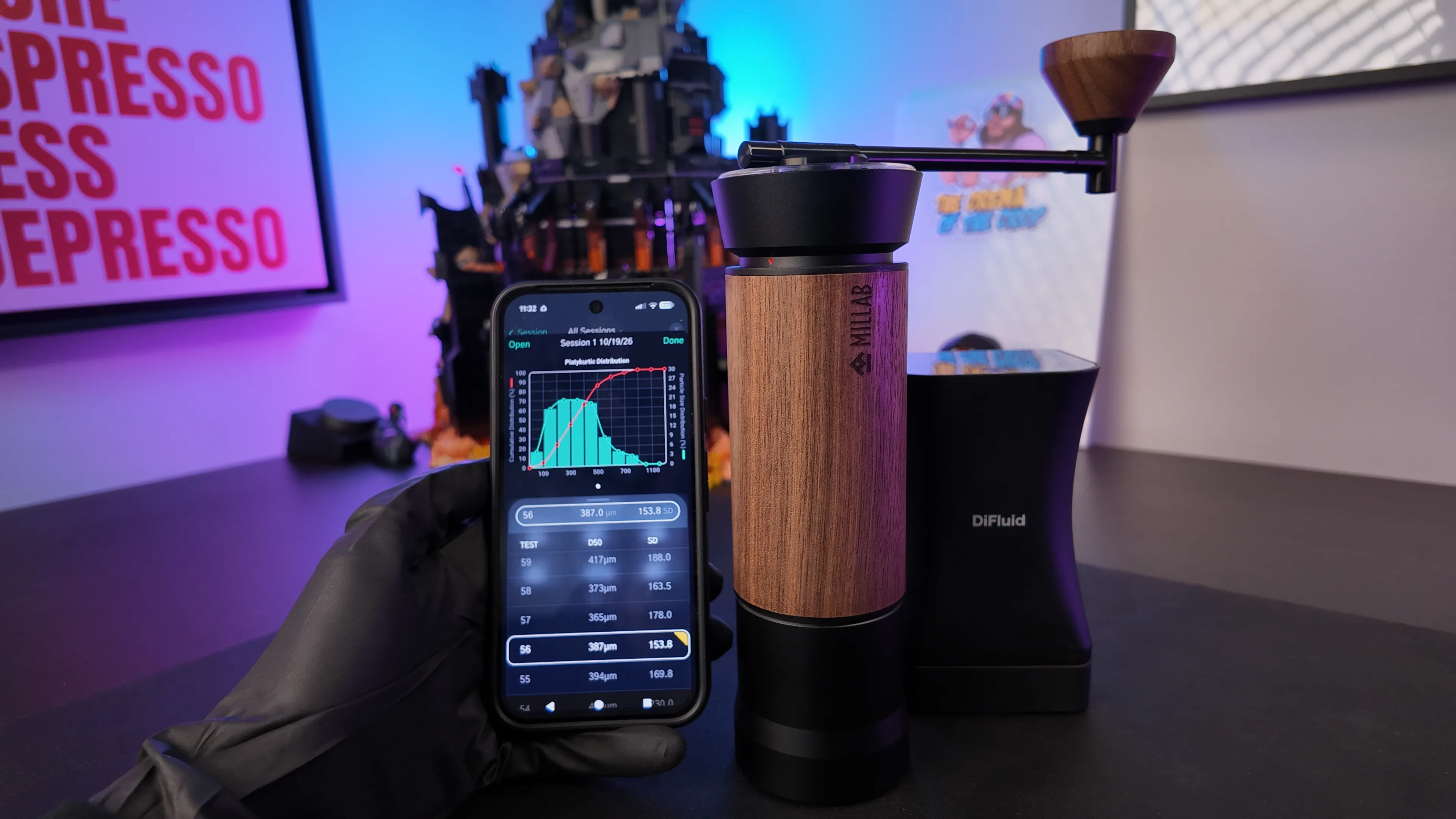
Timemore M01 (Millab) Review and Grind Chart
Wow, this delivers. Luxury feel meets pristine performance. Hands down the best manual grinder.
Grind data is captured via DiFluid Omni NIR analysis. I plot the particle distribution across 16+ settings to identify the 'Optimal Zone' for each brew method. Actual results vary based on roast type and freshness, among others; however, it remains a starting point for dialing in.
This site is 100% ad-free and always will be. This particular review was conducted on a factory-new, calibrated unit, and was not sponsored. I purchased this unit for testing purposes. Purchases made through our links may earn a commission, supporting the testing and data acquisition.
Full Review and Benchmark Test
Millab is a separate team within Timemore responsible for a line of boutique, higher-end products (they’re the COS to Timemore’s H&M).
At the time of writing, they have three grinders to their name: the M01, the E01, and a collab version of the Timemore Sculptor.
Today, we’ll be looking at the M01, a $350 grinder that takes the prize for the priciest hand mill we’ve looked at so far.
What sets the M01 apart is its so-called “pineapple burrs” a unique design that, at least visually, is unlike anything you’ll find in another hand grinder.
Does that design pay dividends in the cup? And is any manual grinder worth $350? Let’s find out.
Features
- Millab’s 44mm pineapple burrs
- 100 total grind settings
- Stepped adjustments of 12.5 microns per step
- Available in Quicksilver + Carbon Grip, or Matt Black + Walnut Grip
- Included commemorative coin and cleaning brush
Unboxing
As you would hope for a grinder with this price tag, the unboxing experience of the M01 has the feel of a luxury product.
The grinder comes in an eggshell box with very little text outside of a small Millab logo and product name written in embossed gold on the front. If you didn’t know what was inside, you could be easily fooled into thinking you were looking at the packaging for a very pricey bottle of scotch.
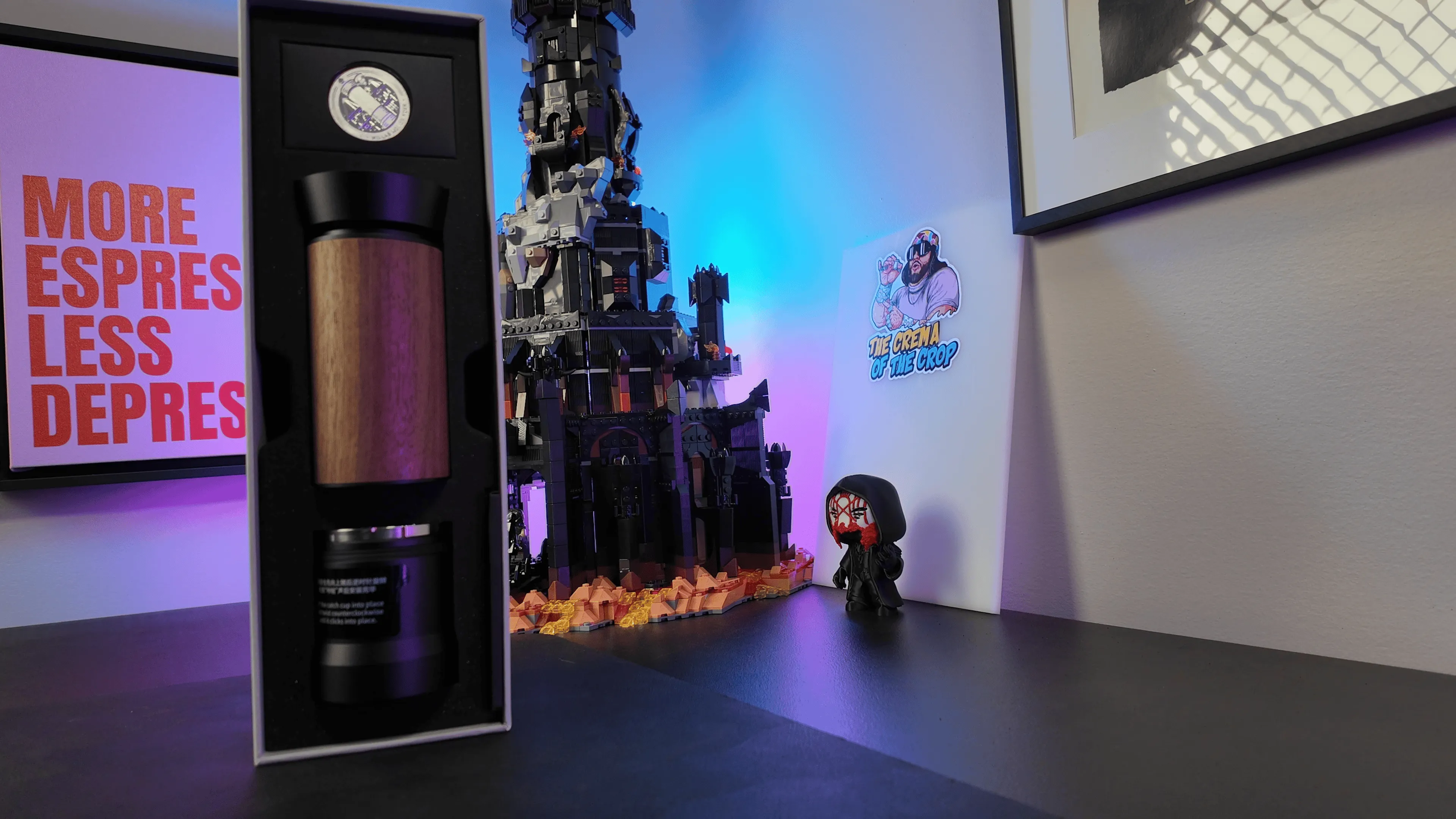
Inside, you’re greeted with the grinder body and catch cup, held in die-cut inserts, and a commemorative coin (brief aside: we’ve said in the past that cheap-looking packaging isn’t such a bad thing if the cost savings go into the grinder components. The commemorative coin looks nice, but in a grinder this pricey, maybe just knock $5 off the price and save your non-coin-collecting users the trouble of finding a place to store it?).
There’s also an elegant cleaning brush which is a far cry from the cheap, plastic-y brushes that come with most hand grinders. Finally, there’s the straight metal handle and wooden grip (aluminum if you’ve opted for the Quicksilver + Carbon colorway).
As far as first impressions go, the M01 offers as strong a feeling of luxury as it’s probably possible to get from a piece of coffee equipment. Top marks so far.
Design
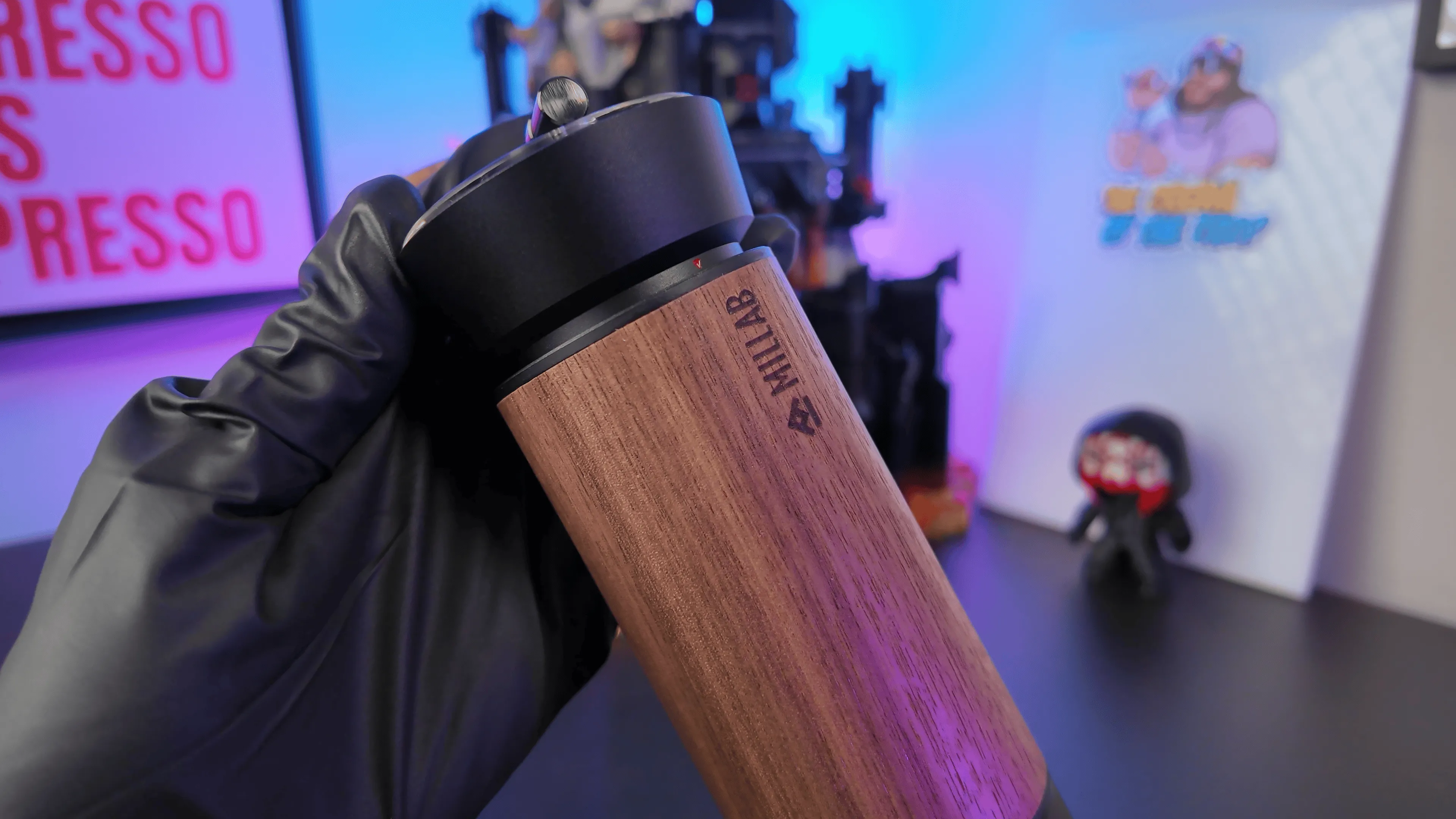
The first thing you’ll notice with the Millab is its heft. It weighs in at 2.4 lbs, and while that weight speaks to its build quality, it’s worth noting that this is less a grinder you’ll want to sling into a tightly-packed backpack for the weekend than it is one that will sit permanently next to your coffee setup.
The only plastic to be found anywhere in the M01 is the transparent grinder lid. The rest of the grinder is made up of aluminum alloy, stainless steel, and (in the case of the Matt Black + Walnut colorway) wood.
A lot of care has clearly gone into every element of the design. The grip is made of either walnut or a striated aluminum, which never feels like it’s at a risk of slipping despite the lack of a rubber grip.
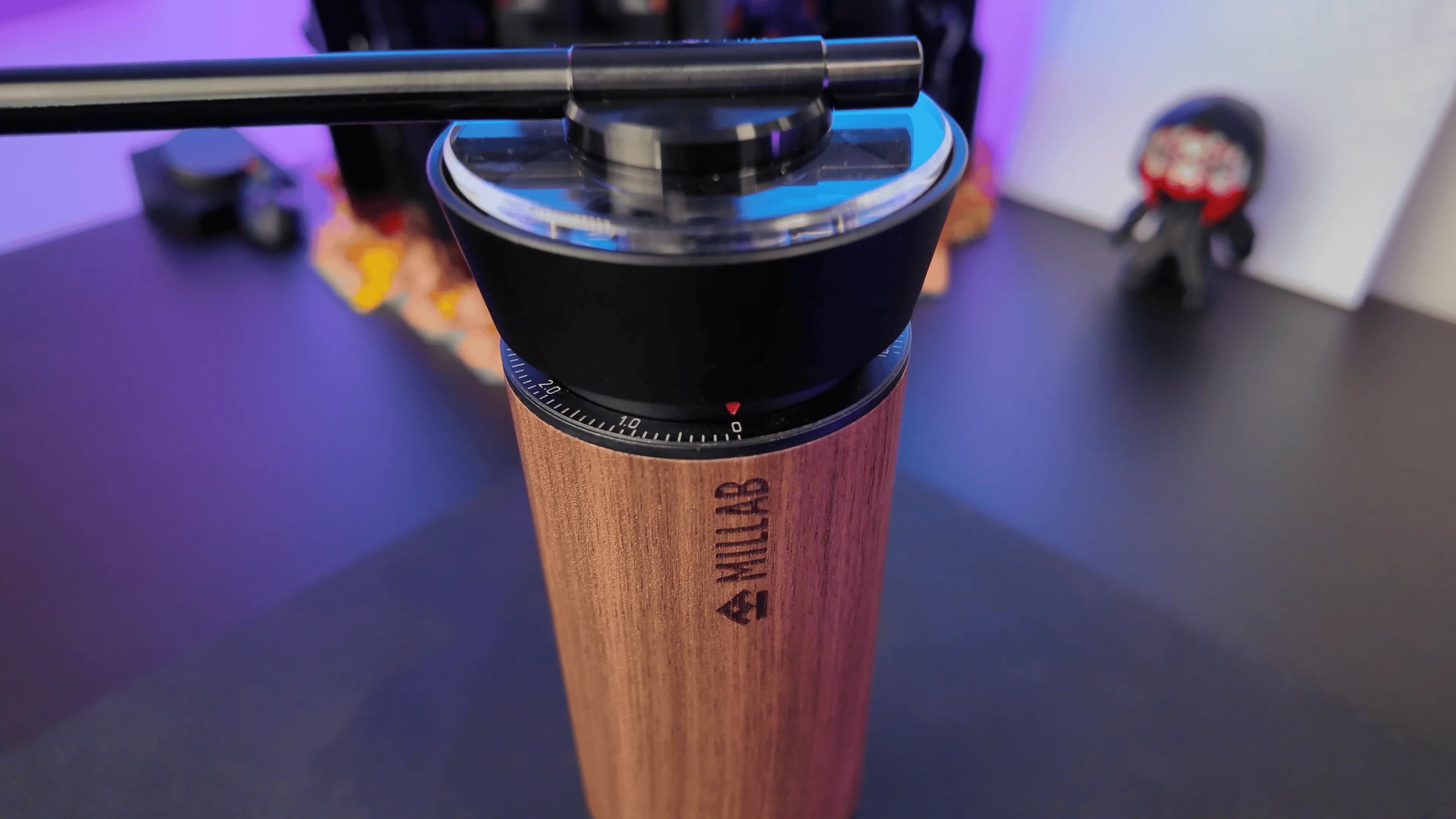
The grind adjustment is external, but it sits far enough above the grip that you’re very unlikely to ever accidentally change settings while grinding.
Millab’s marketing materials devote a lot of words to the amount of time that went into making the adjustment dial precise and accurate. The P7 bearings that are supposedly behind this are clearly doing their job, because every click feels satisfyingly solid.
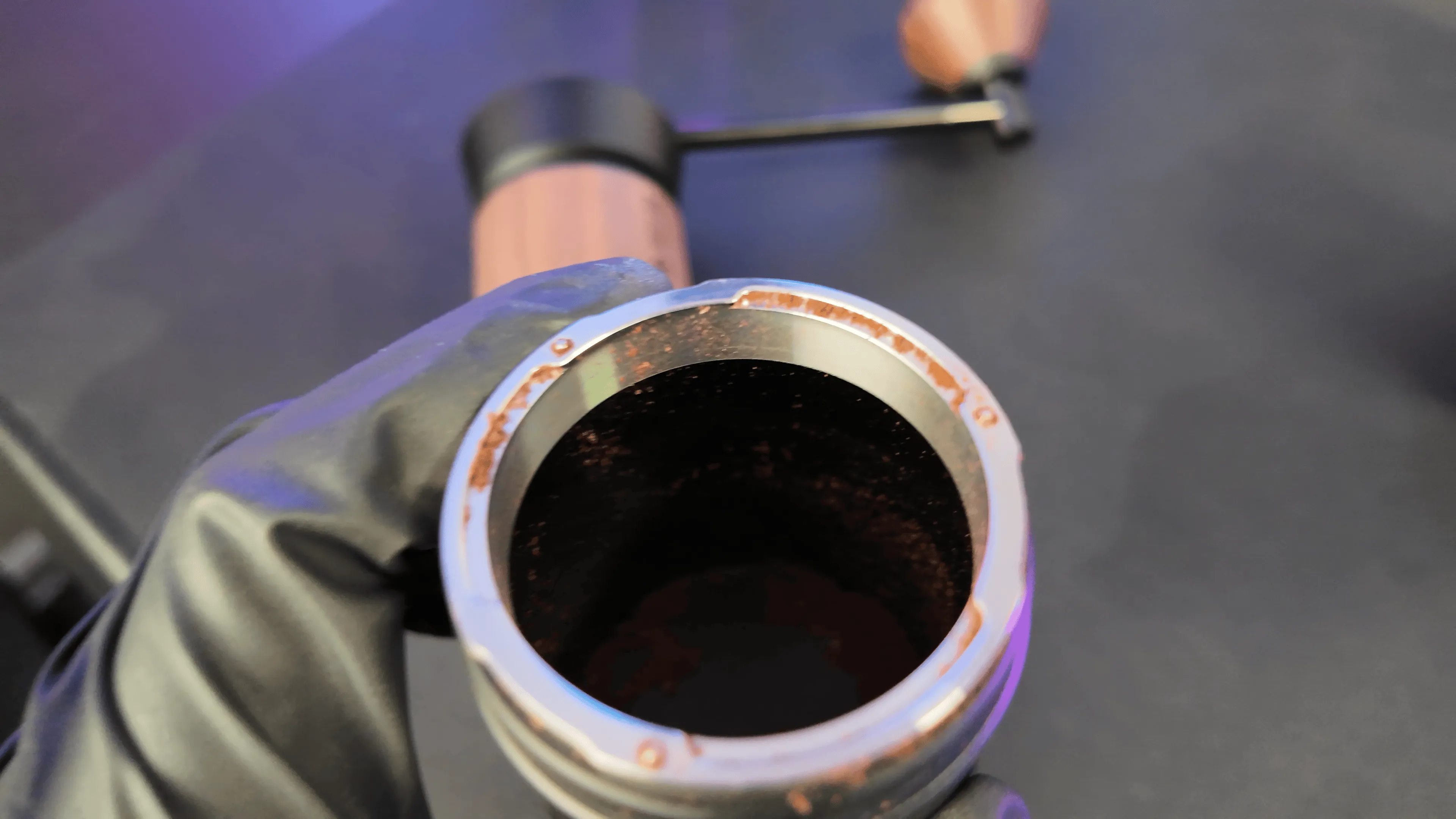
The catch cup is held in place neither with magnets nor threading. Instead, the M01 uses a locking mechanism that threads the needle of feeling secure while grinding, while also being easy to access. I love the design, but be on the lookout for grinds accumulating in the creases; you'll want to brush it out every now and then.
If there’s one design drawback, it’s that the choice to go with a completely straight handle makes for a less ergonomic grind than something like the Comandante C40 or 1Zpresso’s J and K series.
Still, this is a beautiful and luxurious-feeling grinder. Which is good, because anything less for $350 would be serious cause for concern.
Let’s move to the internals, because that’s where the M01’s design really stands apart from every other grinder we’ve reviewed.
Burrs & Calibration
The M01’s pineapple burr gets its name from its unique geometry of the inner burr which resembles, well, a pineapple.
Standing at 30mm (compared to the 20mm of height you’d find on a standard Timemore grinder), the heptagonal pineapple burr has multiple levels of cutting blades.
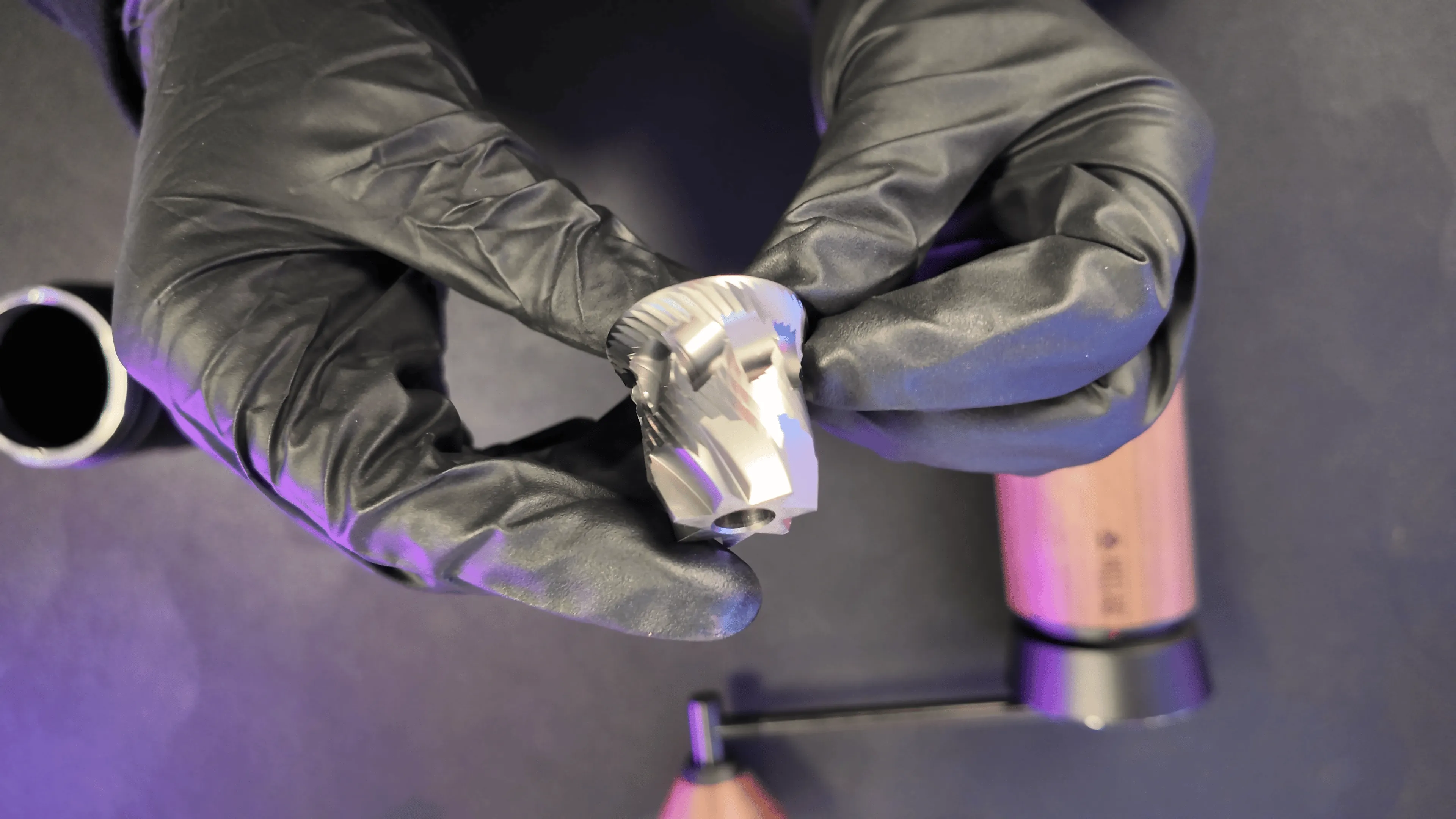
The design includes an initial pre-breaker stage, followed by a set of finer cutting blades. This is followed by a secondary breaker stage, and yet another set of even finer blades beneath that.
By the end of their journey through the pineapple, grounds are meant to be 10% more consistent then those on Timemore’s S2C burrs (an already very-high bar). We’ll see how that claim bears out in the testing below.
Disassembly of the M01 is super straightforward, with the burr mechanism held in place with a lock knob that doesn’t require any tools.
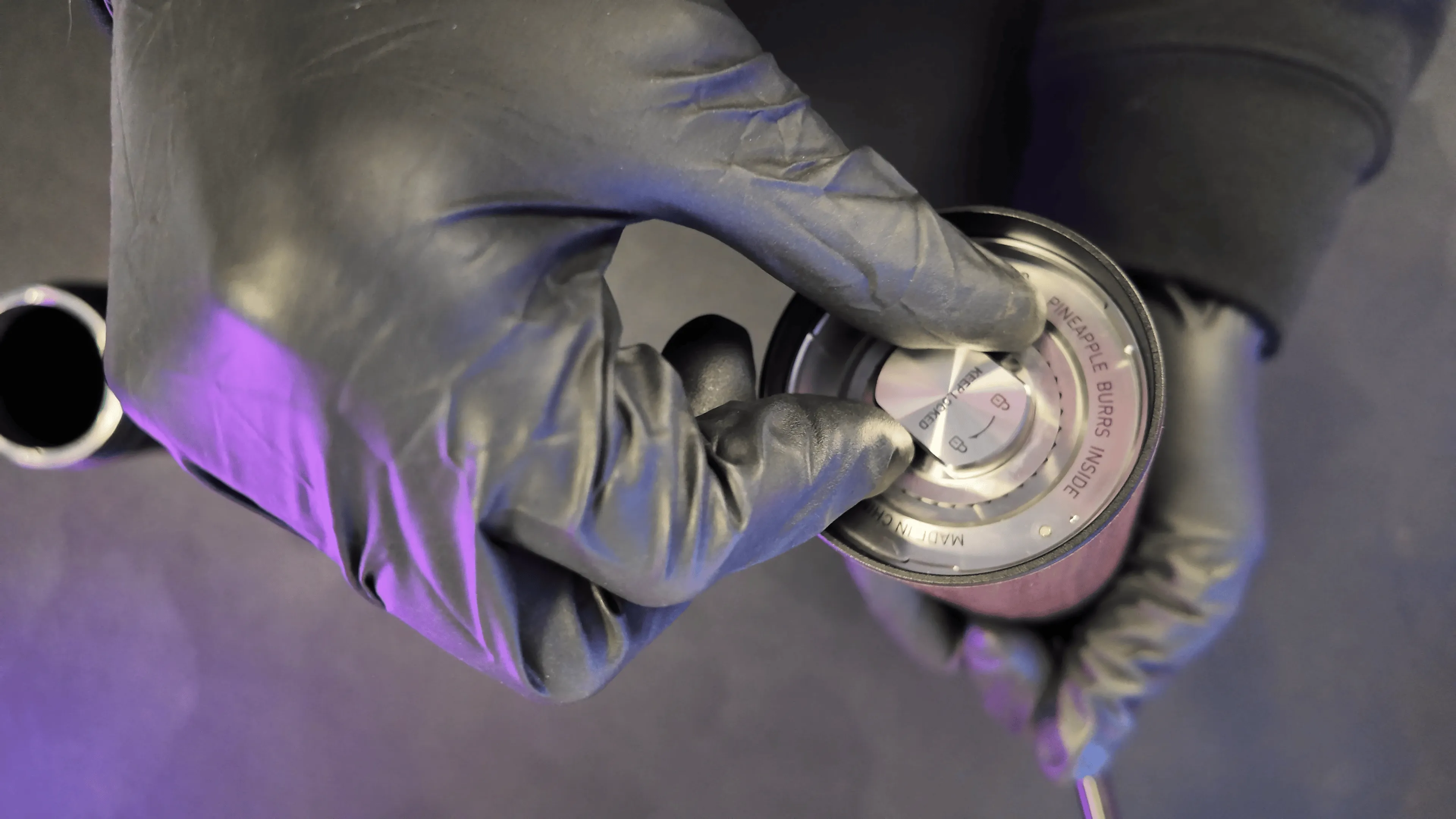
The mechanism is also set up to prevent the need of calibration either on purchase, or after reassembly. You can dial in at your ideal grind setting, disassemble the grinder, and put everything back in place without having to find 0 again.
The M01 is an all-rounder, offering 12.5 microns per adjustment, making it more than precise enough to dial in espresso despite having a stepped adjustment mechanism. As to how that precision translates into taste, we’ll get into that below.
Performance
Particle size distribution
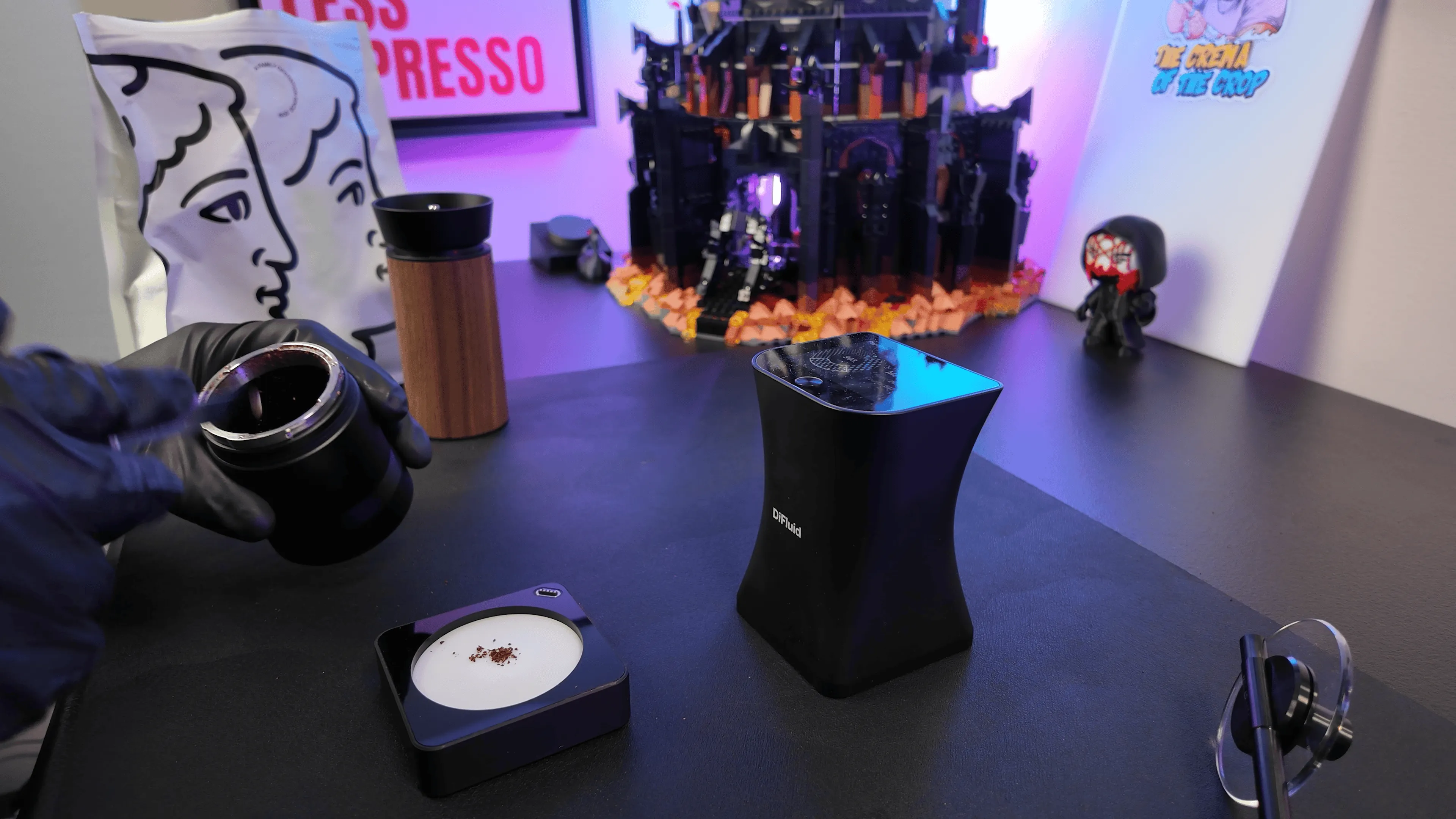
I ran this through my DiFluid Omni particle analyzer 5 times at each setting, for a total of 50 data points. And… my oh my. An overall repeatability rating of 3.4%! This is by far the most consistent grinder tested to date, even beating the electric Gevi VelPro I just reviewed which uses 64mm flat burrs and a variable RPM motor. For comparison, the average repeatability rating for manual grinders I’ve reviewed to date is 6.4%.
At Setting 5, I recorded an insane 0.8% repeatability rating, with the D50 (um) particle measurements coming in at 697, 699, 692, 685, and 697. But what’s most surprising to me is just how accurate this remained in the coarse ranges. At the max Setting number 10, which was over 1,000 um particle size, I saw a 2.2% repeatability score. The KINGrinder K7 (which is a great pick for pour over) saw scores in the 6% - 8% range, where this M01 fell closer in the 2% - 4% range.
Now, I’ll add my usual disclaimer: this is not conclusive data on overall performance. With a sample size of 5 data points per setting and using bessell’s correction, we can get a good feel for repeatability but more data captures will be preferred.
The only oddity I noticed was between Settings 7 and 8, the latter of which had a slight drop in mean particle size when you’d expect an increase. But this seems to be a not-too-rare occurrence, with the same thing happening on the KINGrinder K6 and Timemore C3 ESP Pro. It’s very likely that more data points will smooth the curve out.
Fines Generation
Every grinder on one axis: median particle size (D50) against the percentage of fines below 300µm. Lower is cleaner at the same grind size.
Fines are the share of each scan's particle distribution below 300µm, averaged across every run at that dial setting. Benchmark values are the mean of the interpolated fines curve across each brew range (Espresso 350–500µm, Pour Over 600–850µm), using only the portion of the range a grinder was actually measured across.
Retention
As expected for a legit hand mill, retention is really no issue. You can use RDT for net zero, or skip it and just expect 0.1g retained and plan your dose accordingly.
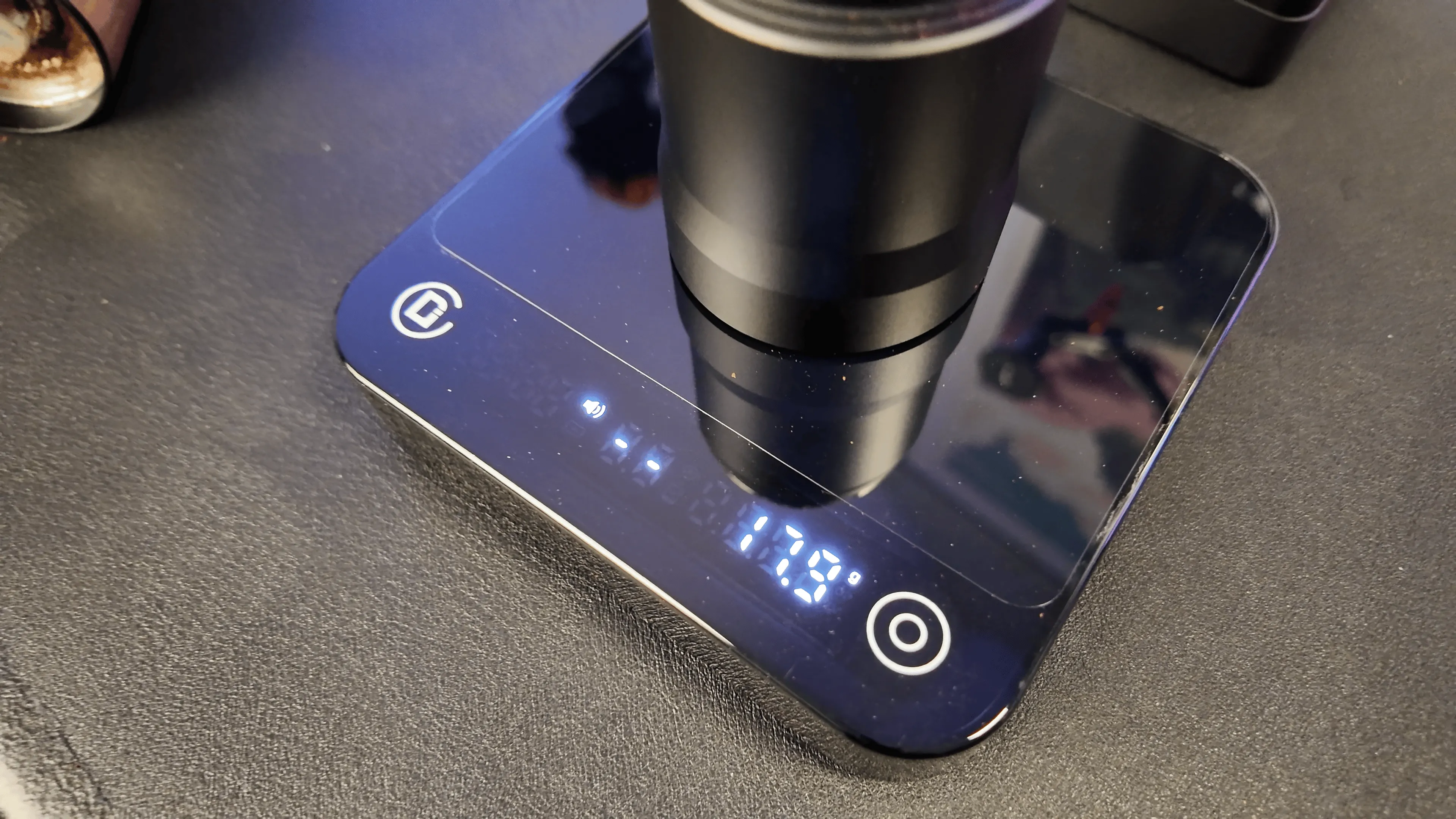
I do not experience any grind build-up in the opening of the catch cup like I did on the 1Zpresso J Ultra, but when you take the cup off of the M01 you’ll want to give it a tap on the counter. A small amount of grinds catch in the open channels of the unique locking mechanism. A light tap is enough to knock them down.
Final Verdict
I was so impressed with the build quality and attention to detail when unboxing this grinder, that I hoped it would be a success. And then the data completely shattered my expectations. So I am fully in love with this thing.
Technical Specifications
| Brand | Timemore |
|---|---|
| Model | M01 (Millab) |
| Adjustment | Stepped |
| Brand | Millab |
| Model | M01 |
| Adjustment | Stepped |
| Settings | 100 |
| Range | 388 - 1243 micron |
| Weight | 2.4 lbs |
| Capacity | 35g |
| Burr size | 44 mm |
Common Questions
- What’s unique about the Millab M01’s burrs?
- The Millab M01 uses 44mm burrs that have an unusually tall geometry, standing at 30mm compared to standard S2C burrs on other Timemore hand mills. That height is used to add two pre-breaker stages and two finer stages which result in fewer boulders and fines making their way into the catch cup. The result is a much more consistent particle distribution than would be found with a set of standard burrs.
- Is the Millab M01 worth $350?
- With the current availability of inexpensive grinders out there, there’s a very real question as to whether you can justify the $350 price tag. If you’re intrigued by the M01’s unique burr geometry and want a luxurious-feeling manual option, there are very few hand grinders that compete with the M01. More importantly, the consistency is, so far, unmatched. For everyone else, you can get a lot of bang for your buck for a fraction of the cost these days.
- What’s Millab’s relationship to Timemore?
- Millab is a separate team within Timemore that functions as the luxury brand within the larger company. Think of them as the COS to Timemore’s H&M.