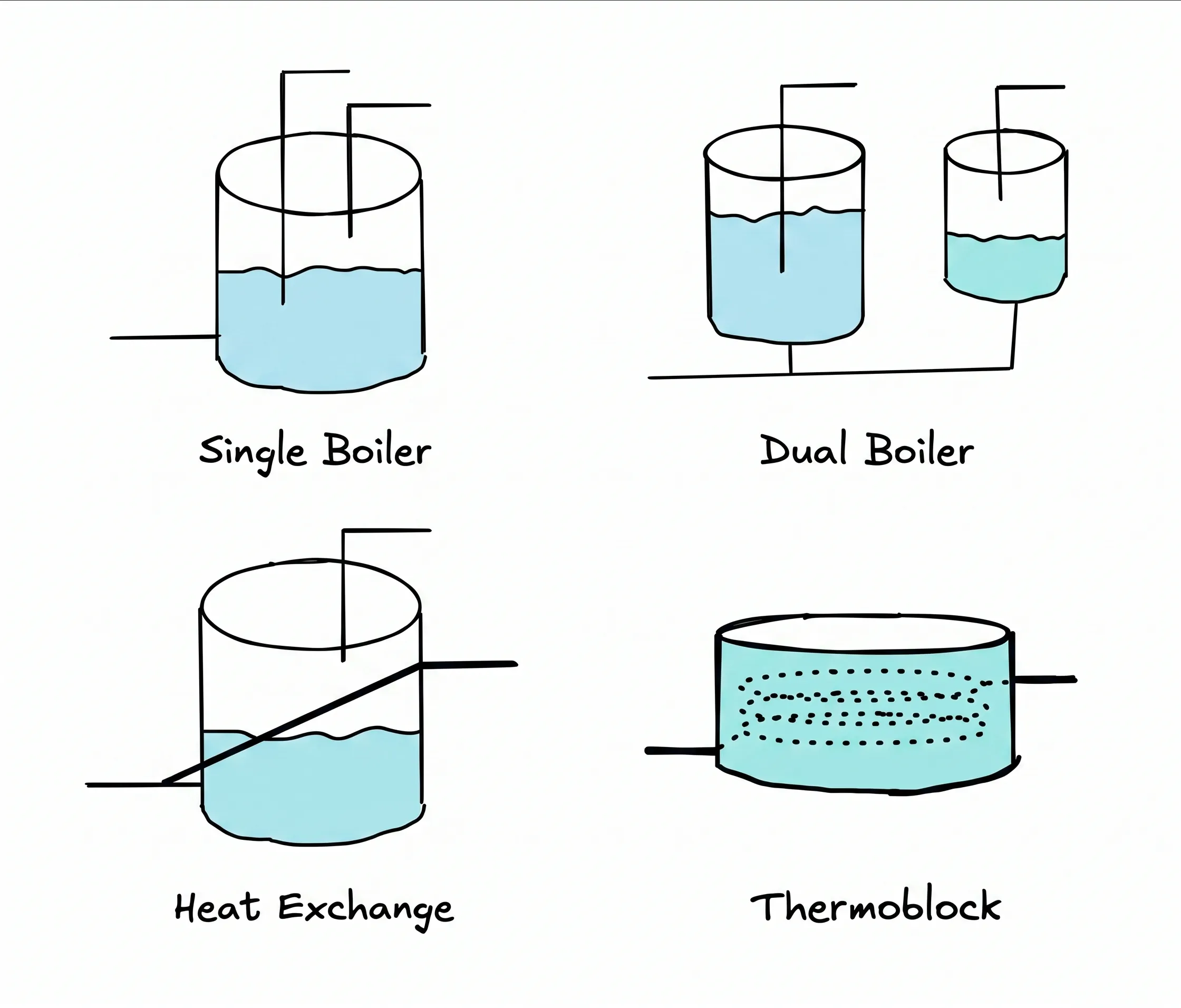
Espresso Machine Heating Systems Explained: Single Boiler, Dual Boiler, Heat Exchanger, and Thermoblock
If you’re in the market for a new espresso machine and want to understand what’s out there, or if you’ve had one for years and want to see if an upgrade is in order, one of the key decisions you’ll have to make is around heat architecture: the specific way the machine heats up the water used for brewing and steam.
Which heat architecture your machine uses will have a significant impact on the machine’s price, your espresso workflow, and, ultimately, what ends up in the cup.
In this article we’ll break down each of the main heat architectures:
- Single boiler machines
- Thermoblock machines
- Heat exchange machines
- Dual boiler machines
At the end of each section, we’ll provide a couple of examples of machines in each category that have a strong reputation within the industry, and describe the ideal user for each architecture type so you can figure out how you invest your money.
Let’s get into it.
Single boiler machines
We’ll start with the most basic form of heating architecture, as it gives us an opportunity to explain how boilers work more generally.
An espresso based drink requires hot water for brewing and (in many cases) steam for milk frothing.
The idea of the single boiler goes all the way back to the first espresso machines made in turn-of-the-century Italy. While those machines would make a cup of coffee that would be unrecognizable to us today, they used the same principle, storing their brewing water in a heated chamber, and then pushing that heated water through a portafilter filled with coffee grounds on demand.
A modern single boiler uses a heating element within the boiler to bring the water up to the temperature needed for the function required by the user at a given time: brewing or steaming.
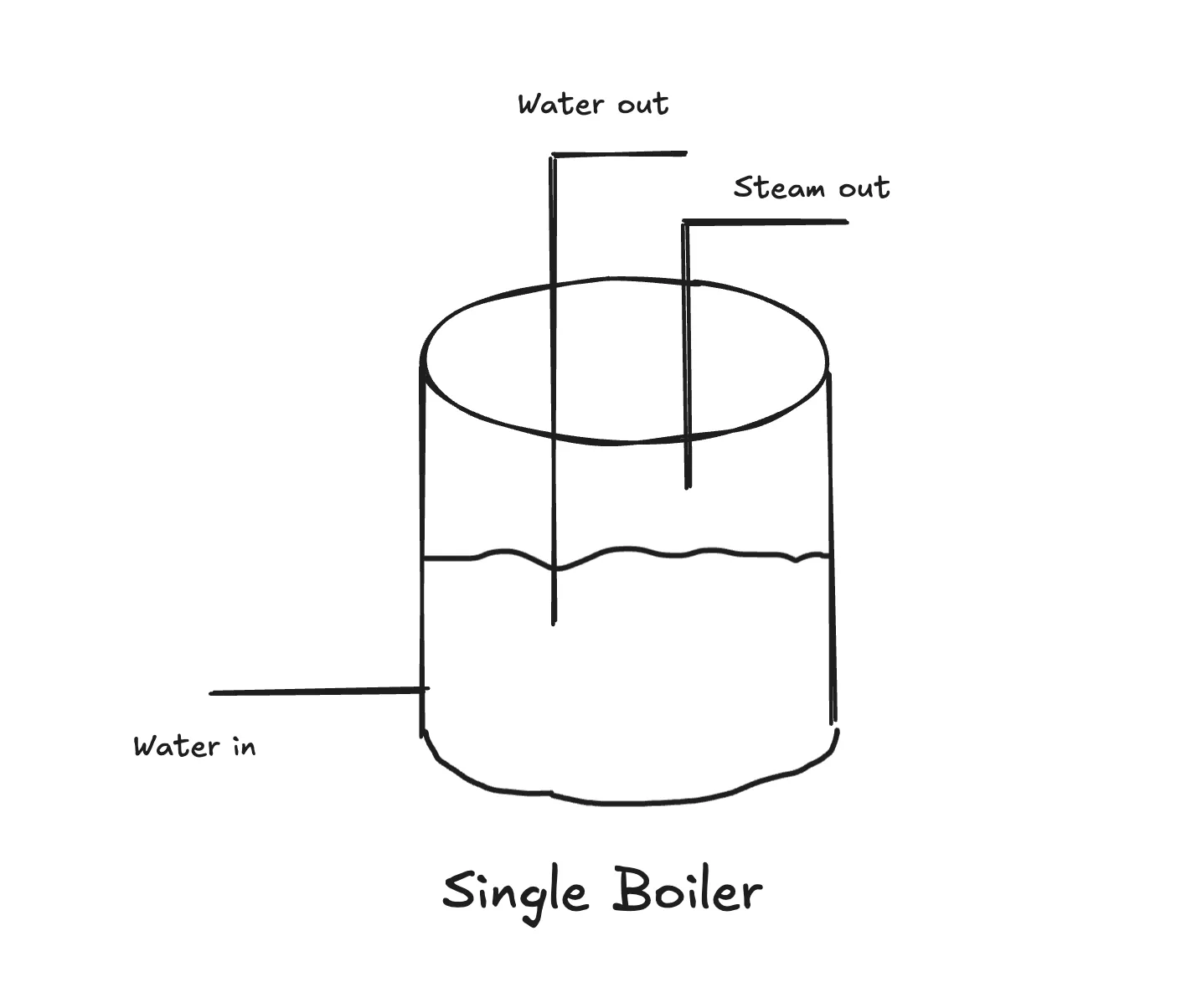
This is where we start to hit the limitations of the single boiler.
The water required for brewing espresso needs to be around 194–201°F/90-94℃, while the water required for steaming needs to be far above 212°F/100℃+.
In a single boiler, changing the temperature of the water depending on need takes time. It takes time to heat up, and it takes more time to cool down. In practice, this means you can’t steam milk and brew espresso at the same time. It also means you’ll be left waiting at several points while making your morning cup of coffee:
- Waiting for the machine to come up to temperature so you can pull your shot
- Waiting for the water temperature to come up further so you can steam milk
- Waiting for the water temperature to come down again if you want to pull another shot
A purge can help the final bullet point along, but even then we’re now talking about fluctuations in temperature that are difficult to control for, meaning more variability from one shot to the next.
If you’re the kind of espresso drinker that drinks straight shots and doesn’t bother with milk, this won’t be as much of a problem. The only real con for you will be the fact that single-boiler machines are typically sold as an entry-level option as they’re cheaper to make. As a result, there are no truly premium single boiler machines out there, and you’ll hit a ceiling when it comes to feature-richness.
That doesn’t mean that a single-boiler machine can’t deliver amazing value.
Take the Gaggia Classic. It’s a beloved single-boiler machine whose popularity has only increased due to the mod community that has sprung up around it. By adding PID control using an aftermarket mod kit like this one, users can unlock temperature control in a single boiler system, albeit, with a bit of extra work.
The same goes for the Rancilio Silvia, a pricier but equally-respected option that can also be improved with aftermarket mod kits.
Keep in mind these are both great machines even without the mods, but adding PID control will help take the guesswork out of temperature control.
Examples
- The Gaggia Classic $449
- Rancilio Silvia $995
Pros
- Inexpensive relative to most other boiler types
- Accessible for beginners
- Ability to mod some models means premium performance can be unlocked on a budget
Cons
- Users need to wait for the machine to come up to temperature
- Not possible to brew espresso and steam milk at the same time
- Temperature fluctuations can be difficult to manage without aftermarket upgrades
Who’s it for
A machine with a classic single boiler is the best option for the espresso drinker looking for a machine under the $1000 mark who doesn’t mind a bit of wait time in their espresso workflow. For those willing to get their hands dirty (or, even better, those who look forward to the opportunity to do so), there’s plenty of value to be found in this architecture type.
Thermoblock machines
The thermoblock architecture type is the only entry in this article that does away entirely with the use of boilers.
Instead, it forces water through a coiled channel that is heated by a heating element to rapidly bring it up to temperature.
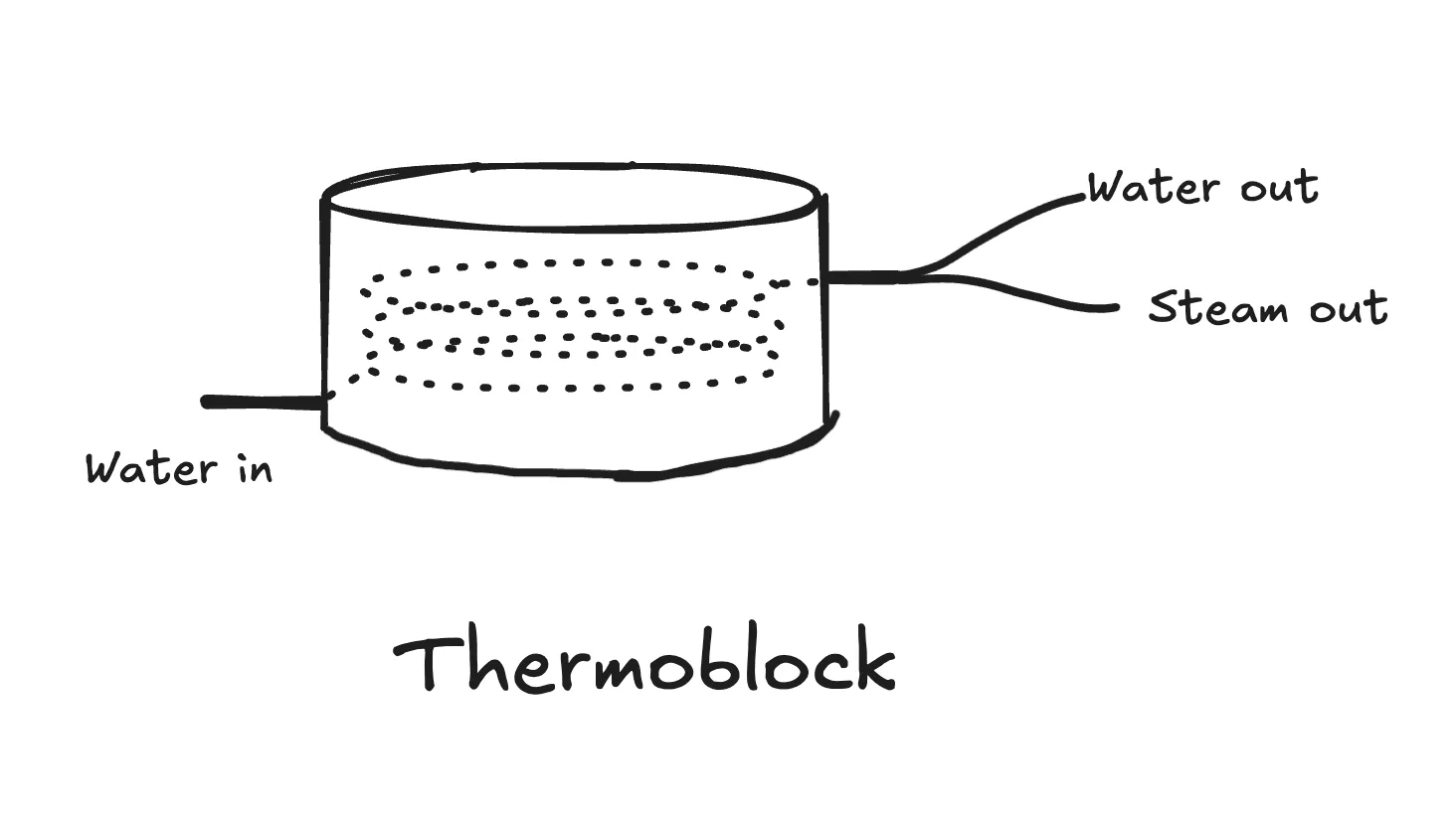
This frees up some space in the machine that a boiler normally would require, while allowing thermoblock machines to come up to temperature far more quickly than a boiler-architecture machine. In fact, Breville’s Thermojet system (which is a variation on the thermoblock design) makes it possible to hit brew or steam temperature in a few seconds.
This means that, while it’s still not possible to steam milk and pull a shot simultaneously in a single-thermoblock machine, the transition between the two functions can happen in such a short window that it won’t be as much of an annoyance.
There is a trade-off here though, and it has to do with thermal management.
Think about the single-boiler type machine we looked at above. The boiler is a chamber full of heated water that radiates heat to the rest of the machine, warming up its surrounding parts. Crucially, the grouphead.
The thermoblock doesn’t build up anywhere near as much thermal mass within the machine, so if your machine has been sitting in a cold kitchen overnight and you pull a shot, the water will be heated to temperature right up until it hits the cold grouphead and the temperature drops.
There is a simple workaround, and that’s pulling a blank shot prior to your first cup of coffee to bring the grouphead up to temperature, but the lower thermal mass makes controlling temperature more difficult overall.
With that being said, the thermoblock architecture also requires far less energy, as it uses heat on demand, unlike a boiler which requires near-constant energy while it’s on to keep its water at temperature.
The only other downside to call out here is steam power. Because water is being heated as it’s sent to the steam wand, rather than being drawn from a boiler full of perfectly-heated water, steam usually exits in a relatively weaker stream, requiring more time spent frothing.
While they’re favored across most of the Breville range, thermoblocks tend to be used in less expensive machines due to their lower manufacturing costs.
The Breville Bambino and Barista Express are well-respected entry-level entries in this category which rely solely on thermojets, while other manufacturers have paired the cost-effective nature of the thermoblock’s design with a traditional boiler to work around the limitations of using either architecture on its own. For example, the MiiCoffee Apex V2 uses a boiler for brew water and a thermoblock for steam, while the Fellow Espresso Series 1 uses what Fellow calls a “boosted boiler” system, where a thermoblock heats water flowing in and out of the boiler.
Examples
Thermoblock only:
Thermoblock/boiler hybrid:
- MiiCoffee Apex V2 $499
- Fellow Espresso Series 1 $1499
Pros
- Quicker heat-up times
- More efficient energy usage
- Affordable
- Accessible for beginners
Cons
- Not possible to brew espresso and steam milk at the same time in single-thermoblock machines
- Lower steam pressure
- The lack of a boiler can make thermal management challenging
Who’s it for
A machine with a thermoblock system is the best option for a beginner who wants a balance of speed, ease of use, and value. The Breville Bambino Plus is the standard bearer of the thermojet category, and it offers solid performance to users who want to pull decent espresso shots without too much fuss.
Heat exchange machines
The heat exchange architecture takes a creative path to solving the challenge of brewing and steaming milk simultaneously with a single boiler.
To do this, it channels the brewing water through a tube that runs through the boiler. The boiler is kept at the high temperature needed to steam milk, and the brewing water increases in temperature as it makes its way through the hot water surrounding it.
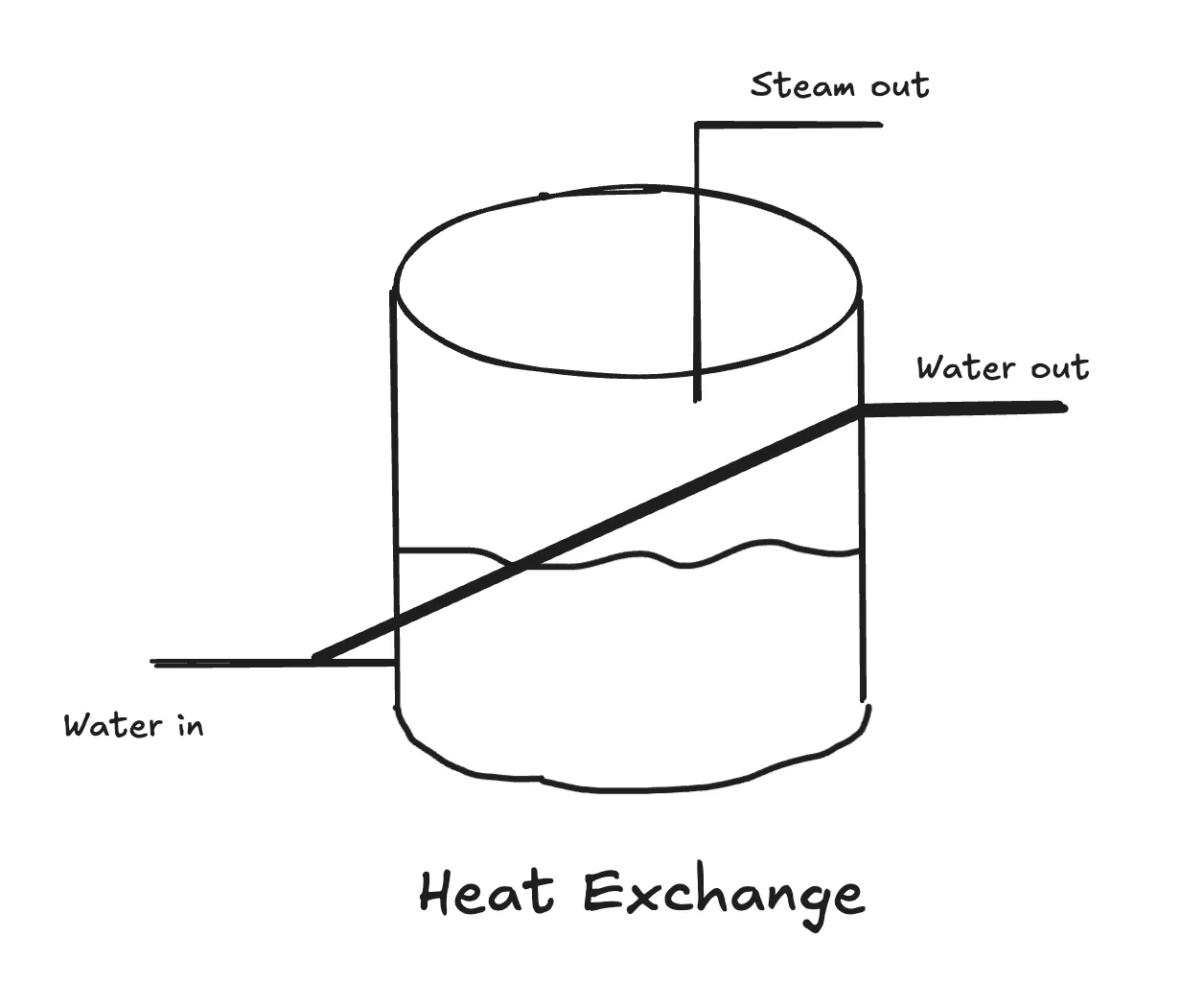
Compared to the thermoblock machines we looked at in the previous category, we get back the strong steam power of the single-boiler machine and then some as well as the ability to steam milk while pulling a shot.
By doing all of this with one boiler, the heat exchange architecture enables machines to take up a smaller footprint than would be required to hold two boilers.
Part of the jump in price that we see when we get to this category has to do with the fact that maintaining consistent temperatures requires additional feature richness in the form of temperature control.
Even so, the brewing water that sits in the tube within the boiler between uses will get too hot to brew espresso, requiring what’s known as a cooling flush between shots.
Because they get us much closer to the brewing and steam performance that would be required in a cafe setting, heat exchange machines sit within the prosumer pricing tier. The Profitec Pro 500 PID is one of the more affordable options available at $1999, while the Diletta Bello+ will run you north of that, adding a digital screen for PID control and programable pre-infusion.
Examples
- The Profitec Pro 500 PID $1999
- Diletta Bello+ $2149
Pros
- Prosumer performance
- Pull shots and steam milk simultaneously
- High steam pressure
- Takes up less space than a dual boiler
Cons
- Need for a cooling flush to control temperature
- Users need to wait for the machine to come up to temperature
- Expensive relative to first two categories
- Inaccessible for beginners/users without professional experience
Who’s it for
A machine with a heat exchange system is the best option for someone with professional cafe experience and the budget for a high-quality machine. As they use space more efficiently than a dual boiler system, a heat exchange option may be preferable for those with limited space.
Dual boiler machines
The dual boiler machine offers the least compromise of any category we’ve looked at.
It contains dedicated boilers for brewing and creating steam, allowing for complete control over the temperature in either boiler. This eliminates the need to intervene in order to regulate the temperature that we’ve seen in every other category.
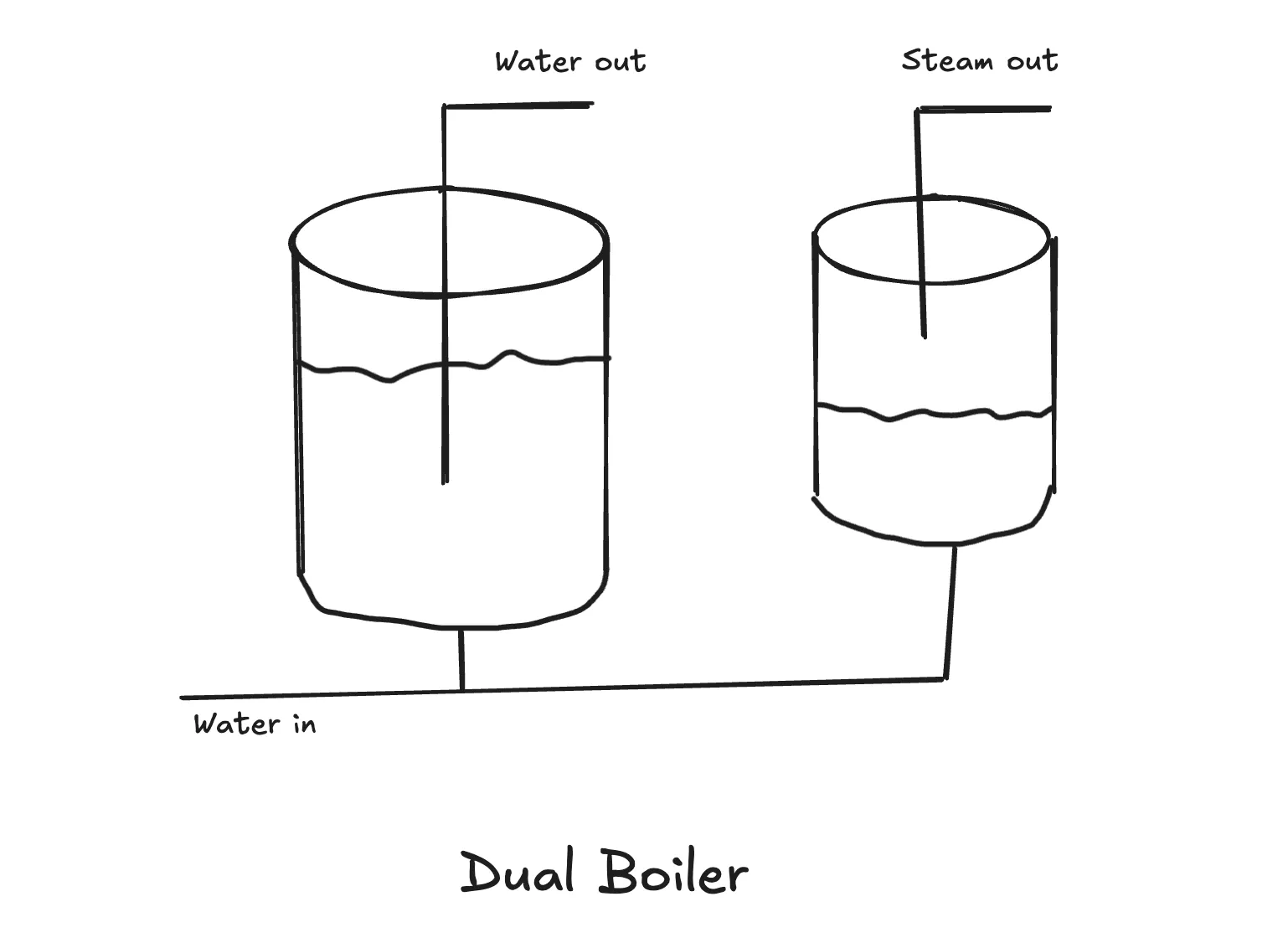
Like heat exchange machines, dual boilers sit within the prosumer domain, and their precision makes them ideal for use cases like competitions or testing for commercial use.
The dual boiler machine has potentially the greatest pricing spread of any category, partially because Breville offers a model that’s so (relatively) affordable in the Breville Dual Boiler at $1599. Double that price and you end up with the Bezzera Duo De, quadruple it and you get close to the Sanremo You, at which point you’re working with a small commercial machine.
Regardless of how deep your pockets are, every model in this category makes it possible to get full control over brew temperature with the trade-off of high energy usage, a large footprint in some cases, and a significant warm up time.
Examples:
- Breville Dual Boiler $1699
- Bezzera Duo De $3,199.00
- Sanremo You $7,950
Pros
- Prosumer performance
- Complete temperature control
- Pull shots and steam milk simultaneously
Cons
- Users need to wait for the machine to come up to temperature
- Expensive relative to first two categories
- Can be bulkier than other categories
- Inaccessible for beginners/users without professional experience
Who it’s for
A dual boiler machine is the best option for someone with significant experience who needs the level of temperature control needed to pull shots to a professional standard.
Conclusion
Shopping around is one of the less-talked-about pleasures of a serious home espresso hobby. Whether you’re sitting at home with an AeroPress and want to dip your toes into the world of espresso, or you’re looking to invest serious cash to get professional-grade results, we hope this guide has set you up with a clearer understanding of the heat architectures available so you can get the most value for your money.